Showing posts with label movies. Show all posts

Friday, December 16, 2011

Match. Set. Xmas.

I'm a little late posting this, but my colleague and pal Christina Amoroso and I did a roundup of sites around the city where famous holiday movies were shot.

I wrote about "Elf" and "Miracle on 34th Street" (the original -- certainly not the remake!)

I also wrote a sidebar about a few more movies with an NYC/holiday setting (or at least partly): Trading Places, Gremlins, Scrooged and It's a Wonderful Life.

Of course, It's a Wonderful Life did not take place in NYC. It took place in (the fictional) Bedford Falls. But BF was supposedly based on Seneca Falls -- a 5 hour drive from the city. While that ain't close, they take it seriously enough so that I sort of felt like I should include them. (An "It's a Wonderful Life" museum and a Hotel Clarence, named after the Henry Travers character in the movie.)

Happy holidays!

Monday, April 18, 2011

The Wiz

I'm a little late getting to this, but as a big movie buff, I don't think an event like the passing of the greatest living film director should pass without comments by yours truly.

I should probably qualify that.

Sidney Lumet, who died last week at the age of 86, was one of only about three (maybe four) people who could be considered the greatest living film director. The only other two I think were seriously in contention were Francis Ford Coppola (who stopped making good movies a long time ago) and Martin Scorsese (ditto, more or less).

I suspect that most of you have seen his three great masterpieces: Network, Serpico and Dog Day Afternoon. If not, you should run out and rent them. They are three of the very best movies of the 1970s (especially Dog Day), bar none. (Network feels more eeriely relevant -- and less like a satire -- with every passing year, particularly with the advent of Glenn Beck.)

But the thing that I'm amazed by, in thinking over Lumet's career, is just the sheer number of first rate movies (that weren't quite as great as those first tier films I just mentioned) that Lumet directed. Sure, he had his share of stinkers. (Like, say, The Wiz.) Some of his movies which were wildly praised when they came out did not hold up well over time. (Like The Pawnbroker.) When he took on social or political issues (like with Fail Safe) he often fumbled (just think of what Stanley Kubrick did with more or less the same material when he directed Dr. Strangelove which came out the same year.)

But despite all this, he leaves behind a titanic body of great work. Here's Max Gross' list of second tier Lumet movies, which you should run out and rent as fast as humanly possible.

12 Angry Men. This one is a little like The Pawnbroker, in that it doesn't quite hold up. And a little like Fail Safe, in that it's an issue movie. But it's also quite clever. And while Lee J. Cobb tends to chew the scenery a bit it still holds up from that era as one of the better "social issue" films. To see just how badly this kind of material could be handled, all you have to do is watch William Friedkin's hopelessly lame 1997 remake.

Bye Bye Braverman. One of the great forgotten Jewish comedies of the 1960s. Every time I get eggrolls, I think of this one.

Murder on the Orient Express. MOTOE almost edges into greatness territory. It has an all-star cast, and it feels like watching one of those stylish, studio pictures from the 1930s with an epic cast, like Grand Hotel, where you expect champagne to flow from the faucets in the sinks. It is also possibly the best-ever adaptation of an Agatha Christie novel. (I think it surpassed Christie's original.) Moreover, even as a big commercial romp, it manages to squeeze in some great moral drama. (The ending was also recently parodied on an episode of 30 Rock!)

Prince of the City. One of the best movies about cops ever made. Period. (I'll never quite forgive the great Pauline Kael for failing to appreciate this tragic, heartbreaking movie. Or Roget Ebert, even though he's kinder.) Moreover, I admire the restraint Lumet showed in the fact that he refused to cast a big name as the lead actor -- he went with Treat Williams, because he didn't want the audience to spend a half-hour getting over their pre-existing associations with a Pacino or a DeNiro. (Sadly, Williams never did anything as good again.)

Deathtrap. For a filmed play, this one is excellent.

The Verdict. I'm slightly biased on this one, because it's based on the novel that my father ghost wrote. But it is one of Paul Newman's best performances. And as a courtroom drama, it is fascinating, riveting stuff.

Daniel. This one is nowhere near as good as E. L. Doctorow's The Book of Daniel about the Rosenbergs (and their kids) but it's worth watching if only for Amanda Plummer's loony performance.

Find Me Guilty. Some were saying that this was a great movie... I'm not sure about that, but it's certainly enjoyable.

Before the Devil Knows You're Dead. Now this is a great movie. Or a near great one, at any rate. The fact that it was directed by a man in his 80s shows just what a master can do when he's in the zone. In addition to being a movie of terrific moral complexity, of the performances one comes to expect in Lumet's movies, it almost looked to me like Lumet had picked up something from Quentin Tarantino. Not just in theme (a robbery gone awry) but in the fact that he decided to play with timelines -- and do so expertly.

For more on Lumet, Slate has an interesting podcast about the man and his work -- which also includes a segment about my old classmate, Mehgan O'Rourke's extremely heartbreaking memoir about her mother (which I will write about later this week.)

Monday, April 11, 2011

Wow -- Matthew McConaughey can act. Sort of.

Hey schlubfans. Sorry, I know I've been bad. What can I say? I was out of town for work. (I'll post the link when it's published.) And I've been hard at work on the new book. (And the Maxette* takes up my remaining time.)

But here I am.

Coming at you with two new movie reviews.

First up, Lincoln Lawyer, starring the slippery, can't-stand-his-annoying-Texas-accent and can't-act-for-shit Matthew McConaughey.

Well, Matt just put me in my place. Turns out he can act. (At least when the role is right.)

Which doesn't mean the movie is great. But it's a hell of a lot better than the same kind of fare you'd find at your cineplex. Lincoln Lawyer is a legal thriller, and McConaughey plays a savvy but extremely cynical (and, at first, extremely sleazy) hustler/lawyer who operates his practice out of the back of his Lincoln sedan.

It's a good office for him -- it keeps him moving. He ferries between courthouses, police stations and jails as he talks with judges, bailiffs, D.A.s and his clients, all of whom are decidedly crooked.

The first few scenes of McConaughey, as he engages in the nut-cutting of a small time lawyer in the big city -- trying to negotiate his clients out of prison sentences (or severe prison sentences) -- are a marvel. Big, burly, violent men ask McConaughey for his help, and with his glib, shit-eating grin and his East Texas twang, he obliges. Brusque, dissatisfied DAs try to bully him into a plea bargain, he turns them down -- with the smile again.

I think the reason McConaughey works so well in this role is because one sort of always viewed him as slightly sleazy and, well, slightly dumb. McConaughey displays little bits of intelligence and cunning in The Lincoln Lawyer, and it comes as a surprise. Who'd have thought there was a mind at work behind those blond locks and that chiseled exterior. Mick Haller (McConaughey) is, likewise, the type who gets a kick out of being underestimated. He gets a kick out of being a lot smarter than he is given credit for.

And he also gets a kick out of being a man unafraid to travel in sketchy circles.

In a way, The Lincoln Lawyer benefits from low expectations. The story Haller/McConaughey is caught up in is not a whole lot more complicated than one would see in a TV drama: There's a case Haller gets that reawakens the conscience long dormant in the cynic. But the simple plot is executed well. There are a few neat plot twists (as well as some things that don't make much sense) but the script itself is probably a solid B+.

Stunningly, it's McConaughey that kept my attention -- he lifts it up into A-/A territory. (That, and a really killer R&B soundtrack. It really is one of the better soundtracks I've heard in a while.)

But if The Lincoln Lawyer benefitted from lowered expectations, Source Code suffers from raised expectations. The New Yorker liked it. As did my pal Lou Lumenick.

But I found it a little dull.

Part of the reason is because the premise was spoiled by every review I've read. If you've not read any of the reviews, this might be an interesting experiment: Stop reading this blog post. Go see it, and decide for yourself. Because I think knowing the premise kind of killed it for me.

Now stop!

The premise is.... Jake Gyllenhaal plays a man who must go back in time to avert a catastrophic terrorist bombing. He has (through the movie's weird rules) only eight minutes to do this. He can keep going back, even after the bomb blows, but he can't alter the past while he's there. The best he can do is bring back information to prevent the next bombing.

But once you know the movie's rules, it's easy to get bored with every trip back in time. If it was a little more cleverly done (if, say, Christopher Nolan had been assigned a rewrite) it might have worked. But I was ready to leave early.

*I can't call the girlfriend a "schlubette" as I did with girlfriends past (hey, Matthew McConaughey reference!) because she is decidedly not schlubby. In fact, she's jarringly competent and put together. Lord only knows what she's doing with me, but I'm not about to question my good fortune.

Friday, February 25, 2011

Oh, I wish I was an Oscar Meyer winner...

Well, it's that time of the year.

The time when Max Gross quietly grits his teeth at the utter rubbish that wins an Academy Award, while far worthier stuff gets the shaft.

And yet....

I sort of love the whole beauty pageant atmosphere... The horse race between spoiled (and often talentless) glamour-pusses... Figuring out just how wrong the Academy is going to get things in their ranking of quality versus dreck.

In short, it's great sport.

And there are Oscar pools to win! (Not to brag, but I've won them before, and I usually place in the top three.)

For this reason, it's important to actually pay attention to the handicappers and conventional wisdom. And to vote with your head -- not your heart.

Nate Siver, who is perhaps the savviest reader of polls in journalism, also does some Oscar handicapping -- but I strongly advise taking Silver's predictions with a grain of salt.

Silver is unquestionably a genius at reading polling information (and correctly modeling it on a computer) but two years ago his model got a number of very important categories wrong. (He predicted Taraji Henson over Penelope Cruz as best supporting actress... and I stupidly listened to him.) And I think the Academy's voting system is a lot more susceptible to whimsy than Silver takes into account.

The Post's Lou Lumenick has his own ranking -- which definitely gets a little more micro than Silver on the categories. (Gruffalo for animated short? OK, Lou. You know better than I do.)

You can also go to intrade (where Colin Firth is given a 94.4 percent chance of winning best actor!) or The Daily Beast, or pretty much any other entertainment web site in the country.

So here's the Gross model on what I think is going to win (based on some of these predictors) and why.

Best Supporting Actress:
There seems to be some division between Melissa Leo (who was really great in The Fighter) versus Hailee Steinfeld in True Grit.

I'm going with Steinfeld. Although it should be noted, this might be a case of wishful thinking, as I think Steinfeld gave the better performance. (Although only slightly.) But I think it will be TG's one major award of the evening, and they will give it to who everyone agrees was the highlight of the film.

Best Supporting Actor:
Christian Bale is a lock. There's some talk about Geoffrey Rush getting it, but I think this is mostly nonsense for two big reasons. (1) Rush has already won for Shine, and (2) The Academy is going to want to give The Fighter a consolation prize.

Best Animated Feature:
Toy Story 3. Duh.

Foreign language film:
Biutiful. Although generally Lou knows better than I do (he picked "In a Better World") -- and I'm very curious to know his reasons -- I think the better known the film, the greater the chance it has to win. And Biutiful (which I admit I haven't seen) is starring Javier Bardem. The director has had a few mainstream Hollywood hits (like 21 Grams and Babel -- two movies I couldn't stand.) I'd say it easily had more viewers and more friends in the industry.

Adapted screenplay:
The Social Network. Both CV and MPG agree. (Although if I were picking the Academy Awards and not for a betting pool, I'd pick Toy Story 3 on that one.)

Original screenplay:
The King's Speech.

I have a confession to make. I haven't seen it yet. I will before the Awards ceremony. (Saturday probably.) But I am not looking forward to it. Everything I've been led to believe tells me that it's the kind of dull, mannered movie I'd hate. But The King's Speech is the favorite to win (by virtually everyone) and so it's unlikely there will be an upset from The Kids Are All Right. (Even though that is the picture I'd give the statue to if I were picking.)

Best Actor:
Colin Firth. I'd prefer to see Jesse Eisenberg get it, but Eisenberg is young. The general reasoning is that he'll have many more chances. Firth didn't get it for A Single Man, and the Academy has a history of making it up to actors next time. (So cheer up Jesse.)

Best Actress:
Natalie Portman. I thought Black Swan was completely ridiculous. However, OK, I accept the fact that everyone and their grandmother thinks this was a harrowing performance. (Whatevs. But I'll just say: Annette Bening deserves it much more.)

Best Director:
David Fincher. This is kind of a hedge (which I'll explain in a second), but, sure, most people are giving Fincher (who has directed some great movies, like Fight Club) the edge over Tom Hooper. I'll buy it.

Best Picture:
The Social Network. This is decidedly not the conventional wisdom. Intrade gives the Kings Speech an 81 percent chance to win best picture. Those are steep odds. And I admit, I'm going out on a limb here (especially having not seen KS yet.) I also admit that while this list is the way I'm voting in my Oscar pool, if SN wins, the chances go down for Fincher winning best director, too. (That's the reason I'm hedging. I'm probably wrong on one of these. But I'd like to maximize my chance to get at least one right than both wrong.)

But here are my reasons:

(1) I think people liked The Social Network more than KS. At least, I didn't hear anybody saying what a good time they had at KS. I did hear that at the SN. And academy voters no doubt feel it's a heady enough movie (which is sort of true) that it's OK to like it and vote for it for best picture.... something they weren't necessarily comfortable with on Avatar.

(2) There have been too many little-movies-that-could that have won the award in recent years, from Slumdog to the Hurt Locker. I think it's time for a well financed studio venture. And while KS has been financially quite successful, SN has earned approximately double the box office. (In fairness it cost much, much more to make than KS.)

(3) Unlike in an election, where people often compromise their favorite candidate with one who has a more realistic chance of winning, few Academy voters are going to vote for KS "because everybody else is." I do think it's slightly worrying that the producers and directors guild voted for KS, but the academy as a whole is bigger than that.

None of these can unfortunately match the fact that KS is the favorite to win by nearly every critic and handicapper. I'm probably wrong. But I sense an upset. In any event, it's going to get my vote on the pool and I'll probably eat crow for all of you on Monday.

Friday, January 14, 2011

My Best Friend's Birthday

Quentin Tarantino's first movie.

Not terrible. Not genius, either. But you can definitely detect Tarantino's sense of humor.

Friday, December 24, 2010

Max Gross sees movies so you don't have to

Yes, you know that the holiday season is fully upon us when the movies that might as well have the words "Oscar bait" sprawled across the poster start coming out...

This year's crop has been mixed. But here's my December roundup of what this schlub has been watching -- from best to worst.

Barney's Version. Not without its problems, but this Paul Giamatti picture (taken from a Mordechai Richler novel), is probably the most fun of all the movies I've seen this month. If you've ever seen (or read) The Apprenticeship of Duddy Kravitz, you know that Richler can present less-than-sympathetic jerks in a jaunty, carefree way that makes you root for them. Giamatti is the jerk in question, and while he hasn't lost his patented sad-sack quality, you can also see exuberance behind his dark eyes. He plays Barney -- a philanderer, a schlemile, a bundle of cruelties, a possible murderer -- who is also lusty and ravenous for experience. We follow him from his first youthful romances until his final one. Dustin Hoffman has the best role he's had in at least a decade, as Barney's gleefully crude father. Minnie Driver is great as Barney's spoiled second wife. My quibbles with it: Giamatti's third wife (Rosamund Pike) was, I think, miscast. (She is very not Jewish.) Likewise, Barney's best friend, Boogie (Scott Speedman) is incredibly not Jewish. And, finally, Giamatti's rival, Bruce Greenwood, was too pure and earnest to be taken seriously, (or liked). But I can't say I didn't enjoy this flick.

True Grit. I sort of wanted to hate this movie for two reasons. (1) I thought it was a dumb idea to try to replace John Wayne in one of the best roles he's ever had. And (2) my parents hated this movie ("True shit," my father called it,) and I generally trust their aesthetic taste. But I can't say I didn't like this Coen brothers remake. While I agree with my father that Jeff Bridges is no John Wayne, he did a good enough job and I admit this new "True Grit" was very well done. It is a darker western than the kind Hollywood used to churn out in John Wayne's days, but that's not a knock against it.

The story is about a 14 year old girl (Hallie Steinfeld) who must hunt down the killer of her father, and enlists Bridges to do the hunting. He's a one-eyed drunkard. Steinfeld is truly spectacular. She plays this no-nonsense 14 year old with a kind of jarring competence. Schlubs who watch this movie might realize that they'll never be as together and in control as this adolescent. (It's sort of maddening.) "True Grit" is really Steinfeld's movie. Matt Damon does a pretty good job as a Texas Ranger, also on the hunt for her father's killer, and while Bridges certainly doesn't embarrass himself saying the same lines as the Duke, he almost tries to make Rooster Cogburn too dark. I also thought Barry Pepper was great in his five minutes of screen time as Ned Pepper. But overall, it was lively, entertaining and a very solid picture. (I'm planning on re-watching the original. I might have to post again on this film.)

How Do You Know. Can anyone explain why this movie doesn't have a question mark at the end? I thought there had to be some purpose behind it, that it might be some relevant plot point. After all, a movie company doesn't churn out tens of thousands of posters and ads and trailers without spellcheck or grammar-check, right? But after thinking it over, I'm pretty sure it was just an oversight... and the reason is because I think a lot of this movie was sort of carelessly thrown together. How Do You Know is a romcom with Reese Witherspoon as a professional softball player trapped between two guys, an easy-going major league pitcher (Owen Wilson) and an earnest businessman who might be going to jail for fraud (Paul Rudd). What did Paul Rudd do? Nothing. Or so we can believe. The filmmakers don't take the time to really explain what he's being accused of.

Writer-director James L. Brooks (whom I'm a great admirer of) sort of painted himself into a number of corners with this movie. Rudd is faced with an impossible choice -- go to jail for a couple of years, or send the guilty party to jail for the rest of their life. Rudd's either an incredible sucker, or a selfish dick. How can this be resolved? It can't. At least not in the way Brooks set it up. The end feels enormously unsatisfying. Moreover, Paul Rudd (who I also like immensely) tries too hard to be winning. (I felt like cringing on a number of occasions.) He doesn't have the necessary chemistry with Witherspoon to make this movie fly.

Which isn't to say there aren't some good parts. I laughed out loud on several occasions. The dialogue is good and the characters interesting (Witherspoon in particular had the most depth and grit of the bunch). But this is one I'd wait to see until it came on TV.

I Love You, Philip Morris. This is a movie about a cop (Jim Carrey) who realizes that he's (1) gay, (2) patently crooked, (3) in love with Ewan McGregor. Carrey leaves his wife and children, moves to Florida and starts living the life of a con man charging his spending sprees on phony credit cards. (The movie does contain the immortal line: "Being gay is really expensive.") When he goes to jail for his transgressions, he meets and falls madly in love with McGregor, the eponymous Mr. Morris, and when he gets out he goes all out to keep his lover in style. (There was nothing in this movie about the cigarette company -- much to my disappointment.)

Carrey goes all out in this role. And ILYPM is a rarity: an unapologetic, mainstream gay comedy. (There's no message, no great battle, nothing to interrupt its hedonistic ethos.) I wish I liked it more than I did, but the story jumps over the place and began feeling pretty dull by the middle. Although, I will say that it's worth watching for the plot twist at the end, which almost made the whole thing worth while. Almost.

All Good Things. Not so good. The story of Robert Durst, the heir to one of New York greatest real estate families, is a truly fascinating (and truly weird) story. Lord only knows what happened, but some time in the '80s, Durst's wife disappeared. Almost 20 years later, Durst's best friend, Susan Berman (daughter of gangster Davie Berman), was murdered. A year later, Durst turned up in Texas, wearing dresses and living with some old Jewish guy named Morris Black who later turned up dead and dismembered in Galveston Bay. What the hell was Durst wearing dresses for? What was the relationship between him and Black? Was it sexual? Did he have a hand in Susan Berman's murder?

All of these questions would make for an interesting picture.... but for some inexplicable reason, this part of the action comes up in the last 20 minutes or so of Andrew Jarecki's lightly fictionalized version of the Durst story (the name here is "Marks.") Instead, Jarecki made the bizarre decision to focus on the unhappy marriage and the disappearance (read: murder) of Marks' wife. Talk about burying the lede...

Monday, December 13, 2010

Xmas movies not about Xmas

Slate has a pretty good roundup of alternative Xmas movies. Not straight up Xmas movies like It's a Wonderful Life (which I go back and forth on between thinking it's a complete piece of shlock or a flawed work of genius), but under-the-radar ones. This is when Xmas is almost incidental... but nevertheless a character in the movie. And whose role might be bigger than initially thought.

Like, say, Die Hard.

Michael Agger's analysis of the great Die Hard is an extremely funny one -- I hadn't ever thought of the scummy Euroterrorists as anti-Santa Clauses. And it's probably the best one on the list.

I would also like to point out that in nearly every one of his movies Shane Black makes Xmas a character. (Lethal Weapon, despite the fact that it stars the odious Mel Gibson, should probably be on this list.)

Also, I would add Gremlins (a childhood favorite) and Go! (hipster, ecstasy fueled X-mas.)

Thursday, October 21, 2010

Two in one week!

Wow! Apparently, there really are people out there reading FSTS... (Some of whom are not even friends of mine! I'm amazed!)

This week I was contacted by a reader at College Crunch who is apparently a fan.

I didn't know of CC before; it's a resource for college students (and college student wannabes). In addition to the stuff about how to get a BS in Psych at the U. of Phoenix, they've got a good mix of articles about movies and TV.

I particuarly like the fact that they're big list makers. (Almost every journalist likes the top ten -- or top five -- list.)

Every top 10 list ever written, of course, has plenty to disagree with on it -- but that's part of the fun.

On CC's list of the top 10 animated features, for instance, they rank Finding Nemo at number 6, but Pinocchio and Dumbo didn't make the cut. (I might be alone in finding the Albert Brooks character in Finding Nemo unbearably annoying.) Outrageous! I still tear up at the "Baby Mine, Don't You Cry" lullaby in Dumbo. (And I'm not even going to mention the fact that they list Tuesdays With Morrie as one of the must read books before you get to college.)

But that's the point of lists, isn't it? To spur angry dissent, arguments, and your own alternative list. So, schlubfans, check out College Crunch and see for yourselves.

Tuesday, September 21, 2010

Sorry Schmucks

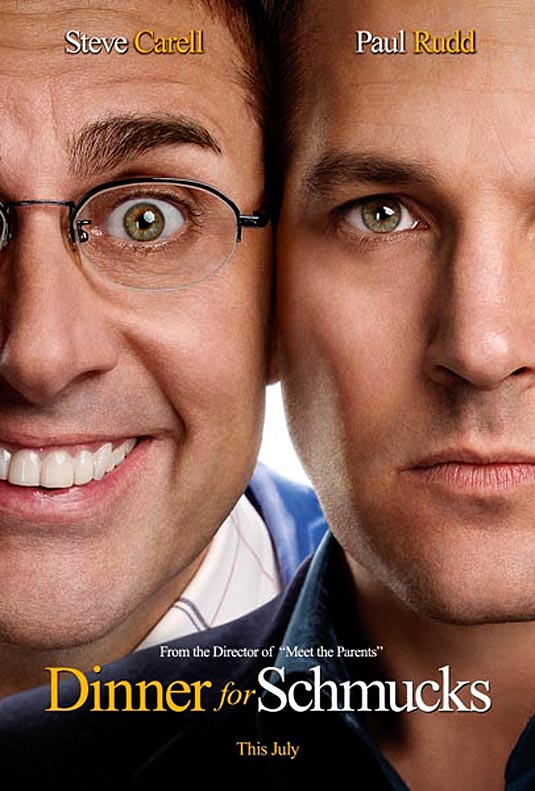
As an avowed defender of the spazzes, schlubs and oddballs of the world I was sort of looking forward to Dinner For Schmucks --

That turned out to be a mistake.

I did not laugh once through the entire picture -- not once!

For the seven or eight people out there who don't know the premise of DFS, it's about a bunch of plutocrats who invite assorted misfits over to a monthly dinner where they can be ridiculed behind their backs. Paul Rudd plays a guy trying to get in good with his rich colleagues. Carell plays one of the eponymous "schmucks."

A movie about hunting down exotic idiots and bringing them for a mean-spirited "performance" of sorts, could have been entertaining. But you would be well advised to skip this movie -- it's a disaster. Among the movie's fatal flaws:

1) Steve Carell is not schmucky-- he's stupid.

Carrell plays Barry, the sort of nerd who's so utterly cut off from the rest of us that has no idea how creepy he comes off.

Which is fine as the underpinnings for a comic character, I guess, but Carrell wasn't particularly funny. We're supposed to find it hilarious, for instance, that Carell's prime distraction in life is something he calls his "mousterpieces" -- handmade set pieces from literature or history that Barry populates with dead mice. (Which he stuffs himself.)

Are you laughing yet?

2) The filmmakers almost seem overly worried that they're mocking Carrell.

I think the film's uncontroversial guiding philosophy is that the weirdoes of life are people, too, and should be treated as such.

OK, sure, I'll buy that.

But just because you treat someone with respect, doesn't mean that you have to be their pal. If someone is so dumb that they ruin your life (as Carell does over and over again) you're allowed to be angry and call them a jackass and not risk moral turpitude. Carell wasn't simply a sweet, feckless sort of manchild. He was utterly oblivious to how much havoc he was wreaking in Rudd's life. Rudd was well within his rights to despise him.

3) Where's the Yiddishkeit?

I feel for a movie with the word "schmucks" in the title, you need some sort of underlying Jewyness. Aside from the title, the word "schmucks" is never uttered. And none of the characters are Jewish.

I'm not saying that they needed to throw Jackie Mason into the movie, but where did this title come from if the movie is not Jewish in any form? I feel that was a form of false advertising. (There is also some question, as my old paper The Forward asked, as to whether the more proper title would be, "Dinner for Schlemiles." But I'll leave that one to the Yiddish scholars out there.)

4) The side characters are all unfunny.

Since The Hangover, I've been a fan of Zach Galifianakis but what the hell is he doing here? He plays an intense "mind control" IRS agent, who can apparently slip in and out of Barry's thoughts at will.

You have to wonder what the studio execs said at the meetings when this character was discussed.

Maybe they thought that a comedian of Galifianakis' talent could pull it off and they wouldn't have to come up with, you know, funny dialogue. Or funny situations.

This should serve as a lesson.

Monday, August 2, 2010

Better than All Right!

"Max," my landlord once said to me, "don't marry someone you love -- marry someone you can buy real estate with."

It's not bad advice.

Not that I can speak from experience, but I've always assumed that marriage isn't about the roar of passion -- it's about the long slog. (Three day affairs are about roars of passion.)

Lisa Cholodenko's movie The Kids Are All Right is one of the more lovely depictions of the slog I've seen in quite some time.

The basic premise of The Kids are All Right is that Annette Bening and Julianne Moore play a lesbian couple with two teenage kids -- both from the same anonymous sperm donor. When the kids seek their father out it rocks their relationship with their mothers -- and leads to a meltdown between Moore and Bening.

And the thing that I found sort of amazing is that with very little editing the script could have been about a straight couple, and probably would have been equally successful.

Does being a lesbian make a mother any less afraid when her daughter jumps on the back of a motorcycle with a virtual stranger? Or any less angry when said daughter spent the night drinking and clearly drove herself home?

Does being a lesbian mean that you don't sit your son down and have the same uncomfortable talks when you suspect he's starting to think about sex? Or when you don't like his delinquent friends?

The jealousies, the anger, the tension is all there -- as is the tenderness and sweetness.

When Ruffalo shows up, you can tell that he (a single man) is touched by the life that his children and their mothers have built together. He wants to be a part of it. He yearns for it. And the reason is because this is a movie about marriage -- not gay or straight marriage.

"I have nothing against gays," goes the old trope, "I just think that marriage is between a man and a woman."

There's part of me that can no longer get angry when I hear such nonsense. I'm simply too bored and weary to argue. My response upon hearing that sort of line from one of my conservative acquaintances is taken directly from Cher Horowitz:

"Whatever..."

But if a liberal like me can't convince anti-gay marriage advocates to reconsider their position, I wonder if The Kids Are All Right can do the trick.

The Kids steers clear of making any windy manifestoes on the issue. I'm not sure I remember the words "gay marriage" even being uttered. Or even if Bening and Moore are officially married or not.

But you can't watch that movie and feel that the relationship is anything less than a marriage. Or that this couple does anything but honor to the institution. In the end, to paraphrase from Tolstoy, all happy marriages are essentially the same.

Sunday, July 18, 2010

Inception: There are worse ways to spend $12.50

As a rule, I tend to hate dream sequences in movies.

Occasionally, a dream sequence works. Polanski pulled it off in Rosemary's Baby. The scene was not only freaky and horrific (it's the part where Mia Farrow gets raped by Satan) but had the surreal, just-a-little-bit-off sensation of reality that's minutely distorted.

But for the most part, trying to have your characters dream on screen almost always winds up looking silly.

While Michel Gondry's film, The Science of Sleep, might have actually pulled off something akin to on-screen dreaming -- in which things happen that don't make any sense; in which characters come and go without explanation; in which things are repeated throughout the dream with a different shade of meaning each time -- The Science of Sleep was a little dull.

One thing Inception has going for it: It isn't dull.

Flaws aside (and the film has many) it's fairly exciting.

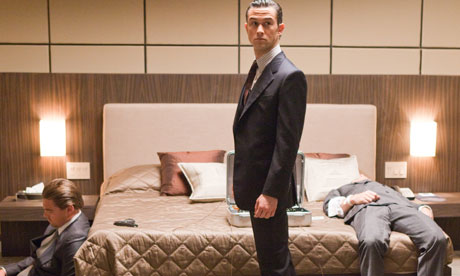
Leonardo DiCaprio plays an industrial spy who has figured out the technology that allows him and his team of experts to invade a person's dream. The director, Christopher Nolan (of Memento fame), spares us any explanation of how this is possible, but instead constructs a clever thriller about how DiCaprio and his crew are hired by a Japanese billionaire with the intention of planting an idea into a rival's unconscious mind -- a feat which is apparently far more difficult than just entering a subject's mind for the purpose of extracting some piece of secret information. (Why? You have to cut this movie some slack.)

When DiCaprio et al. are rummaging through a mark's dreamscape, they know where to find the juicy stuff. (There is always a safe or a fortress in a man's dreams where he keeps his deepest and darkest goods.) They know how to change the landscape to their liking (they hire an architect played by the adorable Ellen Page to do this). And when the movie is going into dreams within dreams -- when the characters are dealing with all sorts of unexpected problems in the dreamer's mind, when they're level-headed and conscious even as the surreal and unexpected are happening to them -- is when the movie's at its best.

When DiCaprio's mark (Cillain Murphy) has been drugged into a deep sleep and he encounters DiCaprio and his men, he senses that something is not right and freight trains and bands of armed men show up to protect him. (He was trained to resist this kind of industrial espionage. Apparently, DiCaprio is not the only person in this dream espionage business.)

DiCaprio must fight his way through Murphy's mind. And they are not only fighting off Murphy's "projections", they also have to contend with DiCaprio's former wife -- a ghost who keeps showing up around DiCaprio to sabotage him.

DiCaprio is excellent -- as he almost always is. His team of dream thieves are also quite good. (I particularly liked the rouge Englishman, Tom Hardy.) Where the movie is weakest, I think, is when it gets too deep into DiCaprio's backstory with his former wife. He must "confront" her -- which I really could have done without. There is some nonsense about not knowing what's a dream and what's real. (Yawn.)

But when they are on a mission to penetrate someone's dream life, the movie is quite good. An action movie taking place in a man's head? Yup, it works.

Sunday, June 27, 2010

The saddest kid's movie of all time?

As a general rule, I'm not a big proponent of kids movies.

Not to sound like a grump, or a killjoy, or like one of those grownups who can't stand children (nothing is further from the truth!). But my working belief is: kids movies are fine -- for kids.

I was always sort of mystified by the throngs of adults who would line up on a Saturday night and shell out good money to go see movies directed towards children.

They're usually boring. Or silly. And enormously condescending towards their intended audience.*

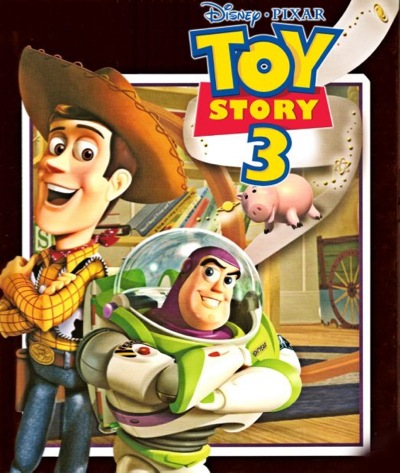
So I'm here to tell my fellow kid movie snobs: give this one a chance. Toy Story 3 is a great movie. (Although you can probably forgo the 3-D glasses -- it would have looked just as good in 2-D.)

Let me qualify that: I'm still not 100 percent sure whether Toy Story 3 was the saddest, most wrenching children's movie I've ever seen -- or the most mawkish and sentimental. But having thought about it for a few days, I'm leaning towards the former.

Having not seen Toy Story 1 or 2, I was worried that I wouldn't make heads or tails of the plot -- but it turns out that isn't much of a concern (minus one or two jokes that had to be explained to me after the fact). Toy Story 3 is very self-contained.

The premise (for the seven or eight people on earth who have not read any of the reviews yet) is about a young boy's toys who come to life when he's not around. He has invested them with certain personalities, which they keep up in the privacy of their toy chest.

It's the same fantasy every child has about their toys. And the animators have come up with a great existential crisis for these toys: Their owner (a boy named Andy) has grown up and is about to go to college. What will happen to them? Will they wind up in the attic? Will they be given away to a daycare center? Will they wind up at the city dump?

The toys end up in daycare -- which sounds OK at first, and then winds up turning into an unrelenting nightmare of crazy, reckless kids who do everything possible to destroy these toys with their horseplay. The fuzzy, pink stuffed bear with an easy drawl named Latso who runs the daycare center (at least as far as his fellow toys are concerned) seems a miracle of kindness and understanding at first, only to reveal himself later to be prime villain of the film.

Latso might have been the most interesting character in the movie -- but I thought all the toys were pretty interesting characters. Certainly a lot sweeter, kinder and more fully realized than you'll find in a Hollywood movie that costs a fortune to make. (According to Box Office Mojo, the movie had a staggering $200 million budget.)

And, for most of the time, the movie is exciting and funny. But I think the added emotional resonance in Toy Story 3 comes from the lingering idea that was sewn into the plot: There is no real happy ending. No matter what happens to these toys, their beloved owner, Andy, will never play with them again. He has moved on.

I remember once when I was a kid my mother coming into my room with a Glad bag and saying, "All right, let's get rid of the things you don't play with." We went through the various action-figures and broken space ships that I was never going to use again. When I handed her a yellow stuffed bear she held it in her hands for a moment and lingered over it for a minute.

"This is too cute to go into the garbage," she finally said, and threw it on my bed.

And I remember being seized with a horrible feeling of guilt - that I was so willing to betray something I once loved.

And yet the truth was, by that point I had grown out of it. That inevitable sense of loss is the same loss that we all feel when thinking about our childhood. We have to move on. We don't necessarily want to go back. But the loss of that idyll is still painful to remember.

And I couldn't have been the only cynical, jaded person who felt that way watching the final 10 minutes or so of Toy Story 3, with moistened eyes. You could hear the sniffling and sobbing all the way to the back of the theater. The only people, oddly enough, who didn't seem very affected by Toy Story 3 were the children. They were for the most part hopping around, laughing and generally enjoying themselves.

Well, in a few years these kids will come to understand just how good a movie Toy Story 3 really is.

****************************************

* For the record: I think there is a big difference between kids movies and a movie or TV show which happens to be animated. No parent, for example, could let their preadolescent watch the series South Park -- but regular readers of this blog will know I think the show is genius. The same is true for The Simpsons (although that one is considerably less profane.) So, no, I don't mind something animated. But what I do mind is something targeted towards kids.

And when I said that I found most children's movies condescending, I stand by that. I've always believed kids were much more sophisticated than adults pretend. They are drawn to a lot more sinister forms of art (like, say, Grimm's Fairy Tales) than the schlock slingers at Disney are prepared to acknowledge. For more on this, take a look at Bruno Bettelheim's great book, The Uses of Enchantment.

Sunday, June 13, 2010

The humor of desperation

Watching the new documentary Joan Rivers: A Piece of Work, I started getting depressed about two-thirds of the way through. This is when Rivers goes to a Comedy Central roast of herself.

If I had managed my investments better, she tells the camera, there is no way I would agree do this.

As she sits in her limo, squeezed off in one lonely corner by the window, she sighs as she anticipates the insults that are coming her way: Plastic surgery jokes, naturally. Age jokes are sure to follow. (She's 77.) The idea that it's a "great honor" is simply ridiculous.

But the money is very good, she admits. (A fact she will bring up more than once.) And while she is hardly living in poverty, keeping up her grand life style requires compromises.

It felt a little like watching Mickey Rourke readying himself for a bout in The Wrestler. There is routine. There is familiarity. There is weariness. And there is a sense of duty about it.

Depending on your perspective, it's either deeply pathetic or somewhat moving. Maybe a bit of both.

Which is more or less the way I felt about this movie as a whole.

There was a time when Joan Rivers was an extremely funny comedienne -- who was better, I think, than she is commonly remembered. She was a sassy Jewish gal -- who was cutting and clever, who was clearly no dope, and who had an unapologetic persona: Jewish American Princess. (The first popular version, in a way.) A princess who was blistering with insecurities, but who was fully aware of them. And who took a certain pleasure in them.

But Rivers has transformed into something else over the years. While she was greatly successful, there was always a sense that she could have been bigger. Her career took a number of tumbles. (After her feud with Johnny Carson, she went into a tailspin.) The plastic surgery made her -- as she herself says -- a joke. And her personal life took its tolls. (Her husband committed suicide in the 1980s.) Her comedy became somewhat meaner and more jaded.

In A Piece of Work, Rivers is at times very funny about her current station in life -- but also one of the more bitter and self-pitying people I've ever seen depicted on screen.

She will turn down nothing. (Including penis enhancement commercials that William Shatner and George Hamilton had the good sense to pass up.) We watch this little Jewish woman hoofing it through airports and casinos -- her face plastered over casino billboards (and even the poker tables) -- and staying in ice bound Wisconsin hotels.

You have to admire such tenacity. Even as you recognize how sad it is. It is far more bearable to endure the indignities of being a vagabond than the agonizing realization that her moment is long over. (She can barely contain her jealousy of Kathy Griffin, her heir apparent, who makes a little cameo.)

This movie is also (at times) funny. Although probably not as funny as a lot of the people in my audience found it. Both the Times and New York magazines articles are overly generous.

But I will admit that when Rivers is in the ratty clubs, trying out new material, I laughed. The mind working behind these jokes is quite sophisticated. (Not much is lost on her.) These jokes are sometimes as barbed and as scatological as the filthy Sarah Silverman. (Not that Rivers would find such a comparison complimentary. She no doubt feels the same rage towards Silverman that she does towards Griffin.)

Most of the best jokes in the movie could not be repeated on a family blog (and, to be honest, I don't remember the build up quite enough to do them justice). But I think my favorite moment is when she's at a tribute to George Carlin and nervously going through all the comedians she'll be sharing the stage with: Bill Maher (brilliant!); Garry Shandling (brilliant!); Jon Stewart (smart!) until she finally gets to Ben Stiller.

"Eh..." she trails off with expert timing.

The joke works because it shows that Rivers is not without good taste and judgement. (And that she's catty as hell.)

Friday, June 4, 2010

The Girl with the Dragon Tattoo -- the movie

Last weekend I went to see the film version of Stieg Larsson's book, The Girl With the Dragon Tattoo -- which was both good and bad.

First, the good part --

It was entertaining.

That carries a lot of weight, these days. For a movie with a running time of 152 minutes, I was not looking at my watch, or wishing for it to end, or stirring in my seat.

Its two stars, Noomi Rapace (the eponymous girl) and Michael Nyqvist (a journalist investigating a decades old disappearance) are terrific. While there is a significant age gap between the two, they carry on a believable (and steamy) romance.

If anything carries the movie, it is these two.

That being said, the movie has some big problems.

1) The violence.

I'd like to think I'm not a squeamish person, but the graphic depictions of rape, murder and violence really did leave a foul taste in my mouth. It's a murder story, so I suppose it's necessary (and violence is one of those curious things in which the more realistically it's pulled off, the worse it makes the audience feel), but one should be prepared.

2) As a mystery, it's a failure.

There were too many red herrings. Too many digressions and diversions. And, when you get right down to it, too many unanswered questions. The movie begins with all sorts of suppostions - very few of them turn out to be true. And it doesn't take a genius to see early on that this is going to be the case.

A couple of weeks ago, I reread Scott Turow's legal mystery Presumed Innocent (which was also a seriously underrated movie) and the thing that amazed me was how all the accumulated clues and evidence made sense by the end. The Girl with the Dragon Tattoo can (and did) have any number of possible villains by the end.

3) It might have been the most anti-male film I've ever seen.

Perhaps that wasn't it's aim. And, I agree, the Michael Nyqvist character was not anti-male. However, there were so many depraved and evil men, that it's difficult to walk out of that movie not wanting to castrate each and every creature on the planet with a y-chromosome.

Saturday, May 22, 2010

Robin Hood: Robbing the middle class and paying rich Hollywood producers

Should a critic (like your humble schlub) comment on a movie he didn't sit all the way through?

Hell yes.

At least, it's my blog, so I can do what I likes.

Today I walked out of Ridley Scott's dreary, convoluted, boring and hopelessly unmerry version of Robin Hood. And I don't mind advising my readers that they should learn from my experience and not waste their time (and money) in the first place.

I can't quite believe it, but this version of Robin Hood actually made the 1991 Kevin Costner version look decent!

At least the Kevin Costner version had Alan Rickman as the evil sheriff of Nottingham, who was still riding high off his turn as Hans Gruber in the first Die Hard movie, and who seemed to take at least some measure of joy in his villainy.

And even though the Costner version was a little dull (as 90 percent of Costner pictures are), there seemed to be some joy in Sherwood Forest. As much as in the old Errol Flynn movies? Not even close. But there was at least some pretense that we were some place enchanted; Robin Hood's confederates were merry men (supposedly); Maid Marian wasn't a prig; the Sheriff was to be booed like a silent movie villain.

And there was an abiding ethos that Robin Hood was a man who stole from the rich and gave to the poor.

This new RH has a weirder subtext -- namely, it seems to be about the evils of taxation on an already heavily taxed 11th century England. Which, I suppose, offers some sort of potent message for the teabaggers and their ilk in Middle America, and that must have been on the minds of the producers. (If they wanted to change the "steal from the rich and give to the poor" ethos, they could have at least taken a page from Mel Brooks' 2000 Year Old Man who described Robin Hood, as a fellow who "stole from everybody and kept everything.")

But the politics isn't really what bothers me (and, besides, I had read enough about the film to be prepared for that kind of political message). What bothered me was the fact that I kept looking at my watch. What bothered me was the fact that I could barely follow the plot (which wasn't really about taxation or the plundering of the poor, anyway -- it was much more about war between France and England).

What bothered me most, however, was the complete absence of joy. Since when does anyone go to a Robin Hood picture to see a bleak, colorless war epic?

I suppose that was how the idea came up in some story pitch meeting. "We should do a realistic Robin Hood," some writer or producer said. And they set about trying to do it in the most ham handed (and badly written) way they could have.

Spare yourselves -- rent the Errol Flynn version instead.

Friday, April 16, 2010

Date Night: Not nearly as bad as David Denby thinks

Seriously: Is David Denby the most humorless man on the planet?

Because that's the only thing I can conclude after reading his pan of the new Steve Carell/Tina Fey vehicle Date Night. (I also think that any fair reader of his far more ridiculous screed Snark would come to the same conclusion.)

Not that DN is worthy of a spectacular defense. It was fine. Just fine. Both Carell and Fey have done better work. But it was also, well, watchable.

Maybe that's faint praise, but that's what I've got. I laughed a number of times. I wasn't particularly bored. And while the plot gleefully ripped off North By Northwest and The Out of Towners -- and was also tangled, loopy and at times incomprehensible -- it was not nearly as silly as the director Shawn Levy's other efforts (like Night at the Museum).

And I'll even go one better: For a studio vehicle, which is commercial as hell, both Carell and Fey do exhibit signs of character. They're both of a suburban, discontented archtype -- but they're also both sweet and fond of their partner. They want to give themselves a good time. They want to enjoy the fun of the city.

But Denby really hated this picture. He calls it "depressing" comparing it (unfavorably) to The Out of Towners (the original) which he calls "mortifyingly square." (Whatevs. The old Sandy Dennis / Jack Lemmon versus NYC picture was perfectly amusing, if not the funniest picture I've ever watched.)

You can come away from Date Night many things -- but depressed? Really?

David, don't take this the wrong way but: You're overthinking it.

Tuesday, April 6, 2010

Cringe, worthy

I have to admit, that I have mixed feelings about Ben Stiller. (Which is a much more positive reaction than you could get out of a lot of my friends.)

I really liked Zoolander. Was it stupid? Oh, sure. But it was also extremely funny. Stiller was sort of lampooning his own brand of spoiled narcissism -- which worked. And there were some legitimately good jokes. (Like, say, the "freak gasoline fight accident.")

Moreover, I've always thought that The Cable Guy, (which Stiller directed, but didn't star in) was seriously underrated. The idea that cable TV is like a smothering, ingratiating friend (Jim Carrey) who tries to take over your life was sort of brilliant. (And sort of true.) Stiller kept things dark and stylized, and I really admired Jim Carrey's Jerry Lewis-like performance.

There have been other movies that Stiller has done which I've admired (Flirting With Disaster), or half-admired (Along Came Polly).

But, yes, I will also admit that a healthy percentage of his shtick is whiney and self-pitying. I find the "humor of embarrassment" pretty unbearable. And plenty of his movies simply stink. (No man, woman or child associated with The Heartbreak Kid should ever be entirely forgiven.)

Which brings us to Greenberg....

All of the familiar Ben Stiller tropes are there. Roger Greenberg is just as much a vain curmudgeon as the character Stiller almost always plays. He is a jobless, middle-aged man who just had a nervous breakdown, and is filled with complaints about youth, traffic, pet taxis, and the overly loud customers at restaurants.

Like Saul Bellow's Herzog, Greenberg's complaints take the form of letters. But unlike Herzog, who is trying to commune with Martin Buber and Friedrich Nietzsche, Greenberg chooses more earthly correspondents, like Michael Bloomberg and Starbucks. And most of his complaints/observations are not that much deeper than the kind of thing Jerry Seinfeld used to joke about in his standup.

But this Ben Stiller is a few shades darker than the one we've seen in the past. He nails the general angst that a man feels at the age of 40 when his hopes and dreams look suddenly unlikely. (Greenberg's dream was to headline a rock band. He became a carpenter.)

And even though this character is meant to be an asshole, he's not entirely unlikable.

Why? I'm not entirely sure. I think it's because he sort of accepts the fact that he's such a jerk. But I think another part of it is that all of us feel, at times, possessive of our privacy. We, too, seethe with hatreds and complaints when we're forced to meet with other people. We have no patience for the larger world -- and, I hate to admit it, but Stiller gets that down very well.

There are a lot of other elements in this movie that are worthwhile; Greta Gerwig is an overly sweet (and extremely down-to-earth) love interest. She's a good 15 years younger than Greenberg, and similar in that she has a certain purposelessness to her life. But Gerwig doesn't seem all that bothered by this. (Maybe she'll be different in 15 years, though.)

She is an excellent foil for this extraordinarily selfish man. It's painful to see how badly he treats her. But, probably true to character. And sometimes that's the best thing an actor can do.

Thursday, March 25, 2010

Three reasons to hate "Green Zone"... two reasons to like it.

After hearing a mix of good and bad reviews about the new Matt Damon picture Green Zone, I decided to see for myself.

Overall, it was pretty bad.

Why?

Well, for a number of reasons.

1) It was too overtly political.

Essentially, the movie is about a WMD inspector (Damon) who finds that America was lied into war. Its thesis is that the Bush administration went to war knowing that there were no WMDs to be found in Iraq.

I'm not quite sure I buy that.

As a chastened supporter of the war in Iraq, there's very little about the Bush administration that I'm not utterly appalled and outraged at in retrospect. They were the most reckless bunch of morons to ever walk the face of the earth. They were guilty of many crimes: Stupidity. Arrogance. Criminal neglect.

But, at the end of the day, I think they were very surprised that there were no weapons of mass destruction in Iraq. On that (and maybe that alone) they were sincere.

This doesn't forgive the error.

The Bush administration had a horrible habit of cherry picking the intelligence that fit their thesis (that Iraq was hell bent on acquiring WMD) and ignoring anything that contradicted it. They saw what they wanted to see, and little else -- which is a grave sin for custodians of power. But if you read Barton Gellman's biography of Dick Cheney, Angler, you discover that months after the fall of Baghdad, Cheney was still examining the raw intelligence reports and calling David Kaye in the middle of the night to suggest possible WMD sites for him to check. Which is not really the behavior of a guy who thinks that there weren't any WMDs in Iraq.

2) Every character was a walking, breathing political spokesperson.

In a sense, I almost feel that Green Zone should be cut a little slack in this, because I remember that back in 2003, almost everybody I knew was itching to engage in some sort of moral, ethical, strategic, tactical philosophical conversation about what the war in Iraq meant; whether it was right or wrong; what would happen there; etc.

Greg Kinner plays an administration official, harping on about the messiness of Democracy. (I think he was supposed to be Douglas Feith, or a broad neocon composite.) Brendan Gleeson is the cynical CIA op. There's a one-legged Iraqi named Freddie, who levels accusations against Damon and makes prononcements about the invasion. An Ahmed Chalabi character and a Judith Miller character all turn up.

But, honestly, nobody speaks in such platitudes.

And these weren't real characters (with one or two exceptions). People are usually a little more complex than a one-idea spokesperson. These people were pretty much stripped of any complexity.

3) It was sort of tedious.

The director, Paul Greengrass, has done two of the Jason Bourne movies, and he employs a lot of the same chase sequences. The last 15 minutes or so, I was really sick of all the running and chasing and gizmo technology. Maybe I'm getting too old for that kind of thing, but I was gettnig very, very bored.

All that being said, I thought there were a couple of things worthy about the film.

1) It sets the scene pretty well.

The images of Baghdad in casual chaos (when there aren't necessarily buildings burning to the ground, but Iraqis who are coming in and out of government buildings with swag) were pretty good.

While the handheld camera shots were somewhat overdone, there were moments when it was used quite well.

2) Amy Ryan was excellent as Judith Miller.

She seemed like the only actor who had any depth; a reporter who had fucked up royally, but who seemed at least somewhat concerned that she had fucked up. But also self-justifying and self-loathing.

As an impression of Miller, it was pretty spot on.

But overall, skip it.

Friday, March 5, 2010

It pains me, but...

I'm betting that Avatar wins best picture on Sunday -- Kathryn Bigelow wins for best director.

The New Republic's Christopher Orr has the same view.

He says that the reason is the numbers. Box office smashes do far better with the Academy than indies. Who am I to disagree?

But I'd also like to throw in my two cents about why Avatar will probably get it:

It was a big collaboration.

Nobody in Hollywood likes James Cameron. But nobody thinks that the technology that went into that movie was anything short of genius. While Cameron might not deserve the Oscar (so the thinking goes) the movie as a whole deserves it. (I disagree. But that's the logic.)

The Academy also loves to split the difference -- and I think they'd definitely tilt towards rewarding someone they like (Bigelow) rather than rewarding Cameron and denying the rest of the movie the award.

After that, the conventional wisdom sounds about right about the winners: Sandra Bullock for best actress (gasp!); Jeff Bridges for actor; Mo'Nique for supporting actress; Christopher Waltz for supporting actor.

I'm going to have to look at what the odds are category-by-category before I figure out the rest of my Oscar pool, but it's safe to say that Avatar will sweep all the tech awards.

Anyways, that's the Gross prophecy. Hope The Hurt Locker edges out a win anyway.... but I'm not betting on it.

Thursday, February 11, 2010

Worst. Date Movie. Ever.

Jessica Grose has a pretty funny article in Slate about what makes a bad date movie... and I think she more or less gets the tone right.

Guys: stay away from the overly sexual, or the overly gloomy. It just won't do you any favors. I speak from experience in these matters.

I once took a girl to see Boys Don't Cry -- which was a twofer on that count. It was the story of Brandon Teena, the girl who passed herself off as a boy (she hoped to have sexual reassignment surgery) and who, upon being discovered, was raped and murdered. I remember sitting in the theater during the rape scene slowly sinking in my seat, and being ashamed of all men everywhere. "Do you want to go?" I whispered to my date. (I sure as hell was having trouble stomaching it.) She shook her head, and we both endured the rest of this unpleasant film in silence.

One should also be wary of an upbeat ad for a movie. I remember seeing the trailer for Your Friends and Neighbors, and thought it looked cheerful and somewhat innocuous -- like a Woody Allen movie or something. I should have paid more attention to the fact that the film was directed by Neil LaBute. And I should have read a review. (This is very important, guys!) But the men in YFAN were the most nauseating, misogynistic vipers you'd ever want to cross paths with. While you don't see anything quite so revolting on screen as the rape in Boys Don't Cry, you might as well have seen something that vile when Jason Patric describes raping a boy in gym class. Ugh.

And sometimes the bad date movie doesn't have to be all that vile or disgusting to be too much of a downer to ruin a date. I once took a girl to see The Talented Mr. Ripley, which was not that bad in terms of horrible things happening on the screen. There are a couple of murders, but I think we both understood that going into the theater. But it was just so dark and gloomy -- with so many homoerotic undercurrents -- that neither my date nor I were exactly psyched to talk about it after the fact. We just sort of parted ways and never spoke again.

If you'll notice one theme to all of these movies, it's this:

They all came out in the late 1990s. I have learned my lesson and since been careful about which movies to invite girls to.

But I will say this: I sort of liked what Grose said about taking a date to see Capturing the Friedmans. No, I probably wouldn't take a date to see that movie... but if I did, I would be interested to hear what she had to say. And, yes, I agree philosophically that if you did have a spirited, fascinating, nuanced conversation, I think it would speak well of the girl, and well of your future prospects. One of those "high risk, high reward" sort of deals. But don't say I didn't warn you.